Linear Temporal Logic Translation via Human-Inspired Self-Constrained Reasoning for Robot Task Specification
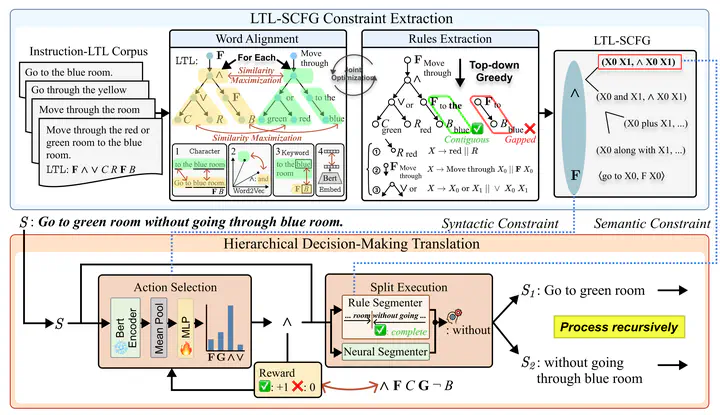 Illustration of Self-Constrained Reasoning framework
Abstract
Many robotic tasks are temporally extended and demand precise specifications of subgoals, constraints, and their temporal ordering. Yet human operators typically communicate such tasks in natural language, which is inherently ambiguous, underspecified, and context dependent. Translating human instructions into formal task specifications, such as Linear Temporal Logic (LTL), is therefore essential for verifiable and safe robotic execution. Existing LLM-based translators attempt to bridge this gap through open-ended reasoning or post-hoc constraint enforcement, but the former may violate domain constraints, whereas the latter can disrupt the reasoning needed for novel instructions. This paper proposes Self-Constrained Reasoning (SCR), a framework that mitigates this trade-off by internalizing structural knowledge into the model’s decision-making process rather than imposing it as an external filter. By combining a structural constraint representation with a hierarchical decision-making formulation, SCR guides reasoning within a formally grounded space while preserving adaptability to unseen instructions. Experiments show that SCR improves both domain-constraint satisfaction and generalization, providing an effective and interpretable approach for translating human intent into verifiable specifications for robotic execution.

Haofei Hou
Postgraduate

Fanxu Meng
PhD Candidate
I am currently studying at the College of Engineering, Peking University, under the direction of Dr. Lecheng Ruan and Prof. Qining Wang. My research interests include Robotics and Biomedical Engineering.